
The passion fruit has to be one of the most intensely and enticingly scented of all fruits. Although not exactly a local food, good quality imports are conveniently in abundance when northern hemisphere summer fruits are out of season.
Enjoy passion fruit on their own, on yoghurt or ice cream, or use them to impart their magical flavor to a variety of fantastic desserts.
HISTORY
Passion fruit are native to the area from southern Brazil through Paraguay to northern Argentina. They were known in Australia by the late nineteenth century from where the seeds were taken to Hawaii.
Passion fruit is now an important commercial crop in Florida, California, Kenya and South Africa.
NUTRITION
Passion fruit are rich in vitamins A and C and are a good source of potassium and iron. The seeds are high in fibre.
BIOLOGY
The familiar purple passion fruit come from Passiflora edulis; a climbing plant that vigorously spreads its tendrils across all surfaces. The variety flavicarpa produces yellow-skinned fruit.
TIPS
BUYING
Choose larger fruit whose weight indicates a reasonable juice content. The fruit are ripe when the skin is deeply wrinkled.
STORING
Store ripe passion fruit in the fridge. Smooth, unripe passion fruit will ripen in a few days at room temperature.
Both the fruit and juice freeze well. Ice cubes made from the juice diluted with an equal volume of water can be served with fresh fruit juices or to enliven a glass of water.
PREPARING
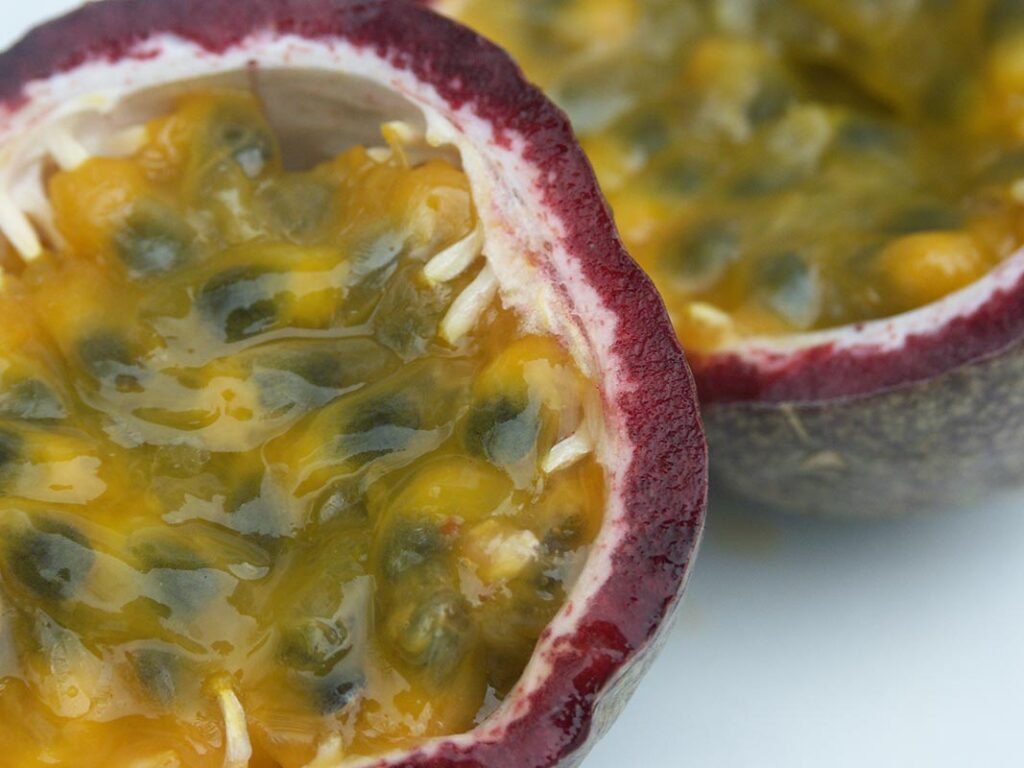
If using the pulp and seeds simply cut in half and spoon out the flesh. To extract the juice, scrape the pulp and seeds against a sieve with a wooden spoon. A lot of fruit are needed for a little juice, but a little juice goes a long way.